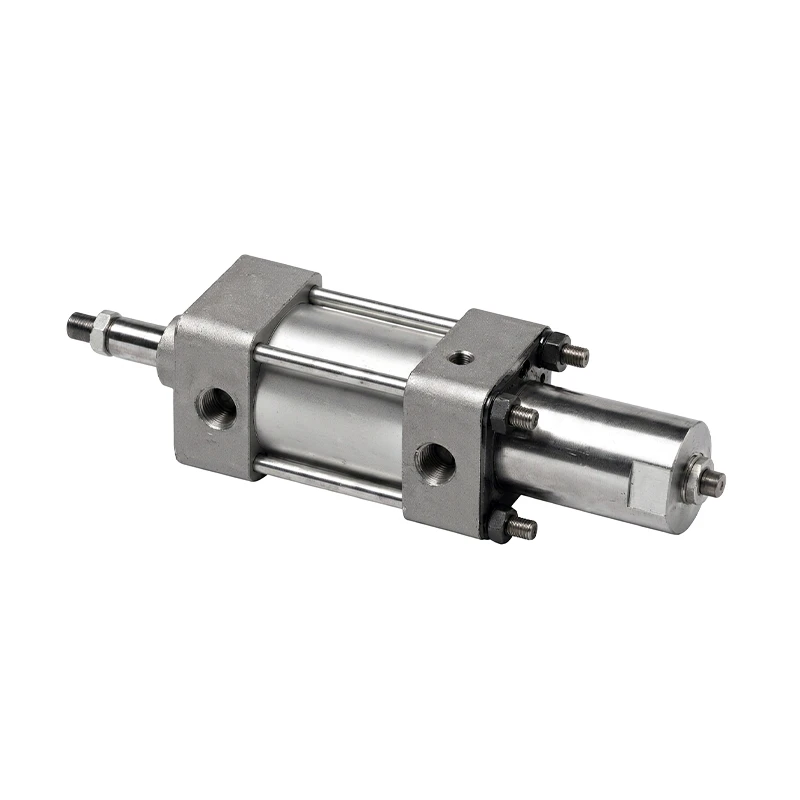

Technical Performance of Cylinders
It is well known that, compared to electric actuators, pneumatic cylinders can operate reliably under harsh conditions; they are simple to use and essentially maintenance-free. Pneumatic cylinders excel at reciprocating linear motion, making them particularly well-suited for the most common requirement in industrial automation: the linear transport of workpieces. Furthermore, stable speed control can be easily achieved by simply adjusting the one-way flow control valves installed on either side of the cylinder-a key feature and primary advantage of pneumatic drive systems. Consequently, for users who do not require multi-point positioning, pneumatic cylinders are generally the preferred choice due to their ease of use. In current industrial settings, electric actuators are primarily employed in applications that demand high-precision, multi-point positioning-a requirement that is difficult to meet with pneumatic cylinders, leading users to opt for electric alternatives as a secondary choice.
Electric actuators, by contrast, are mainly used for rotary and oscillating applications. Their strengths lie in rapid response times and the ability to precisely control speed, position, and torque through a feedback system. However, when linear motion is required, the system must incorporate mechanical transmission components-such as toothed belts or lead screws-to convert the motion. This results in a relatively complex structure, while also imposing stricter requirements on the operating environment and the technical expertise of the personnel responsible for operation and maintenance.