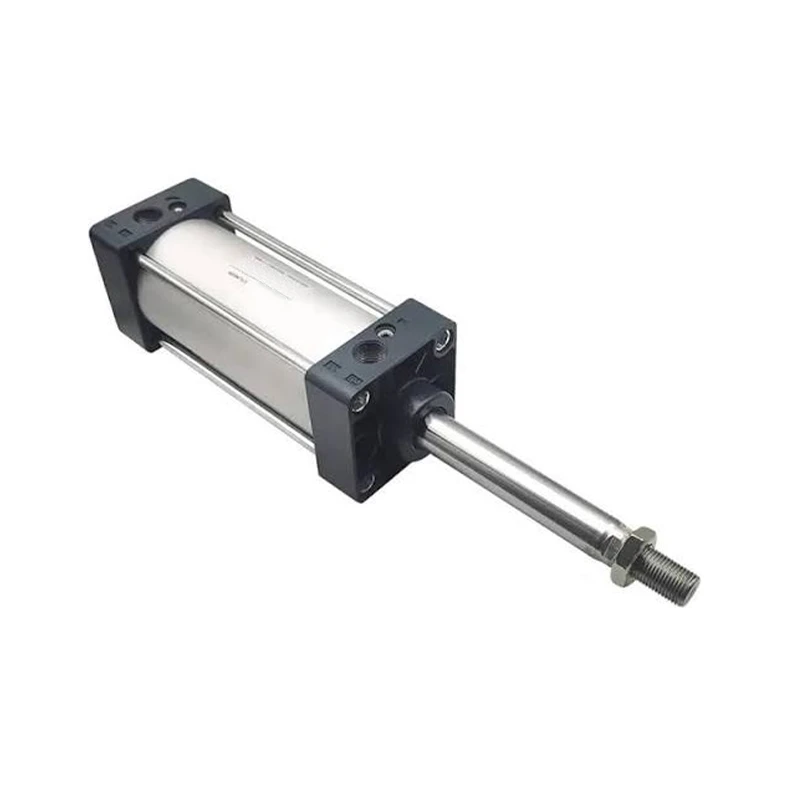

Methods For Controlling Bolt Stress in Cylinders
If the deformation of the cylinder mating surfaces is minor and uniform, the issue can be addressed by replacing bolts at the locations where gaps exist or by appropriately increasing the bolt preload. Bolts should be tightened starting from the center and moving outward toward both ends-specifically, beginning at the point of maximum deflection or the area subject to the greatest stress-induced deformation. Theoretically, bolt preload can be determined using the formula $d/L \le A$; however, as the data and measurement methods for this calculation are still under study and not yet widely adopted, preload is typically determined based on empirical experience, ensuring it remains within the bolt's maximum allowable stress limit.
With further technological advancement, polymer composite materials have been successfully applied in the maintenance of cylinders. Compared to traditional methods, these polymer composites offer superior temperature and pressure resistance, as well as exceptional sealing performance. They exhibit excellent plasticity-remaining uncured when exposed to heat-which ensures that the sealing film remains intact and the integrity of the mating surfaces is preserved. Furthermore, these materials are easy to remove; once applied, they can be wiped off the sealing surfaces using anhydrous ethanol or acetone without leaving any residue. Due to these outstanding properties, polymer composites are increasingly favored by companies that manufacture or maintain cylinders.